Friday 16 / October / 2026
Muscat: Standard & Poor's (S&P) affirmed Oman's long-term sovereign credit rating at 'BBB-' and short-term rating at 'A-3' with a stable outlook, citing continued fiscal consolidation measures and improved economic performance and financial and external positions.
“The stable outlook reflects our opinion that Oman’s fiscal and external buffers--which include liquid government assets in excess of 40% of gross domestic product (GDP) and gross foreign currency reserves of close to 20% of GDP which will support the sovereign against adverse geopolitical developments,” the international rating agency said.
S&P in its report further raised its forecast for Oman’s real GDP growth to accelerate to 3.5% in 2026 from 2.3% in 2025, driven by the impact of Middle East geopolitical uncertainty and sustained by higher oil prices and supply expansion to meet global demand for oil, gas, and byproducts.
The rating agency pointed that over the past five years, Oman has demonstrated a proactive commitment to addressing structural challenges, including budgetary and external deficits and economic growth trajectories.
Central to this progress has been a stronger institutional framework, characterised by enhanced coordination in public finance reforms and governance improvements.
“We expect a supportive oil market and a clear trend toward increased transparency to further bolster this momentum. The government’s commitment to data disclosure--including the regular publication of quarterly GDP, fiscal positions, and international investment position, alongside active engagement in the IMF Article IV process--reflects a maturing institutional landscape,” it said.
“While regional instability presents external security risks, Oman’s strengthened policy foundations provide a robust framework for navigating potential volatility,” the agency further added.
Oman’s reform agenda continues to unfold, S&P said adding that, “Increased coordination efforts across ministries that strive to improve oversight are creating a more durable structure that will support the development goals set out in Vision 2040.”
Many of the targets set out in the 10th development plan for 2021-2025 have been nearly achieved, with total investment reaching 25.5% of GDP relative to a 26.5% target, for instance. Other measures have been surpassed, with (for example) non-oil sector growth at 3.9% relative to a goal of 3.2%.
“Shifting to the 11th development plan for 2026-2030, we anticipate Oman will continue to focus on activating capital market depth, with the Muscat Stock Exchange current market cap at about 37% of GDP and further enhancing regulation for the financial sector,” the rating agency said.
Sound fiscal and current account balances will support the government’s debt and external positions through 2029 S&P said adding that, “Oman’s fiscal and external metrics are benefiting from the rise in hydrocarbon prices, oil output, and supply-chain relocation. Deleveraging initiatives have helped reduce fiscal risks tied to government-related entities. We expect Oman will maintain its currency peg, supported by its accumulated government external assets of about 35% of GDP.”
S&P further forecasts that the government will deliver a fiscal surplus of 4.8% of GDP in 2026. This largely reflects our prevailing Brent oil assumption of $95 per barrel for the remainder of 2026 and is a revision to our previous forecast for 2025 of a minor deficit of 0.7% of GDP.
“Similarly, with our assumption that the Brent oil price will remain elevated, at $80/bbl in 2027, we project a surplus of 2.2% of GDP, with the fiscal position nearly balanced over 2028-2029, reflecting a decline in oil prices. We expect non-oil revenue to increase over the coming four years, supported by improved collection efforts in addition to increased customs and duties in line with growth.”
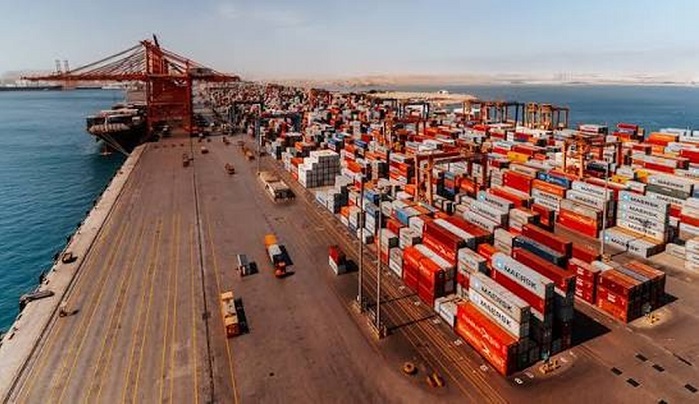
Oman continues to be notably positioned among its Gulf neighbours because its hydrocarbon exports do not rely on the Strait of Hormuz. This has allowed for the unobstructed export of oil and gas through ports that have direct Arabian Sea access, such as Duqm, Mina al Fahal, and Salalah, all of which bypass the Strait of Hormuz.
Hydrocarbons contribute 30% of Oman’s GDP, 50% of good exports and 70% of government revenue, which means access to stable supply chains will facilitate growth and export receipts, in addition to strengthening the fiscal position. “Our base-case scenario for 2026 is that Brent oil prices will average $95 per barrel for the remainder of the year and oil production increases to 1.1 million barrels per day (mbpd) in 2026,” S&P said in its report.
The rating agency further said that indications from the first quarter show non-oil sectors such as financial services, IT, and logistics will reinforce 2026 growth. The 2025 expansion of the golden visa programme and broader family coverage will continue to support growth in the non-oil sector.
“We expect this policy, in addition to the launch of the Oman International Financial Centre (OIFC), to further catalyse investment in property and listed shares, strengthening the country's efforts to deepen its capital markets,” it added.
Meanwhile, the conflict and the effective closure of the Strait of Hormuz indicate Oman’s natural competitive edge as a trading hub will likely strengthen the country’s role as a regional coordinator for alternative transport routes. In first-half 2026, cargo volumes at the ports of Salalah and Sohar rose by approximately 15% and 52%, respectively; notably, ship-to-ship operations accounted for half of Sohar’s volume, likely supporting regional hydrocarbon exports. This strategically fits with Oman’s long-term roadmap for transport sector expansion as GCC countries look to improve their interconnectivity.
S&P further said that Oman will continue to focus on developing its energy generation capacity.In 2022, the government announced a net-zero emissions target date of 2050. To this end, the government is working with foreign investors to develop its liquid ammonia and green hydrogen production capabilities and replace gas in electricity generation, which will ultimately enable the country to become a top exporter of liquid ammonia and hydrogen by 2030.
Oman has the potential to develop low-cost solar and wind energy, given its abundance of land, with renewable energy representing about 10% of the country's total power generation. In 2021, the nation’s annual renewable production stood at 50 megawatts, but this expanded to over 1,600 megawatts by 2025.
Supporting this has been developments such as the Ibri II solar project (500 megawatt output) and the two Manah solar plants (combined output of 1,000 megawatts). Wind has further potential, with the Dhofar Wind Farm Phase 1 providing about 50 megawatts of capacity to the grid.