Tuesday 24 / November / 2026
New Delhi: The Defence Research and Development Organisation (DRDO) has showcased indigenous semiconductor technologies used in advanced radar systems, electronic warfare applications and tactical missiles, highlighting India's growing capabilities in developing critical defence technologies.
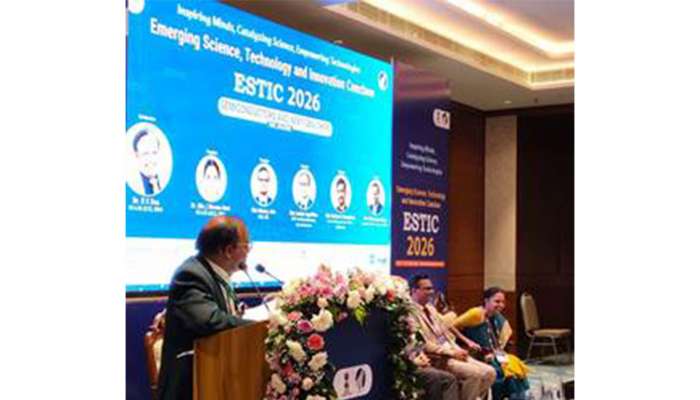
At the Emerging Science, Technology and Innovation Conclave (ESTIC) 2026, held at Bharat Mandapam in New Delhi from October 27 to 29, DRDO displayed Monolithic Microwave Integrated Circuits (MMICs) and Infrared Focal Plane Arrays (IRFPAs), developed by its Solid State Physics Laboratory (SSPL), Delhi.
According to the Ministry of Defence, Gallium Arsenide (GaAs) and Gallium Nitride (GaN)-based MMICs, along with Multi-Chip Modules (MCMs), have been used in several strategic missions. These technologies serve as important building blocks for advanced radar systems and Electronic Warfare (EW) applications.
The organisation also showcased IRFPAs, which function as the sensing elements or 'eyes' of tactical missiles. These systems help missiles detect and track targets during the terminal phase through Imaging Infrared (IIR) seekers.
The exhibits covered different infrared technologies, including Short-Wave Infrared (SWIR), Mid-Wave Infrared (MWIR) and Long-Wave Infrared (LWIR), demonstrating DRDO's capabilities in developing advanced semiconductor technologies domestically.
DRDO also displayed scramjet engine technology and neuromorphic accelerators, along with advanced communication systems, Quantum Random Number Generators (QRNGs), Photonic Integrated Circuits (PICs) and laser proximity sensors.
The organisation was one of the key organisers of ESTIC 2026 and led a thematic session on 'Semiconductors and Next-Generation Chips'. The session was chaired by Distinguished Scientist and Director General, Electronics and Communication Systems, Dr BK Das.
A panel discussion during the session examined developments in semiconductor technologies, purpose-built Artificial Intelligence (AI) System-on-Chips (SoCs), intelligence at the silicon edge and the changing microprocessor landscape. DRDO also highlighted its role in supporting industries and start-ups in developing next-generation chip designs and indigenous technologies.
The Ministry said semiconductor technology is important for national security, economic strength and digital security. It also highlighted the need to develop capabilities across chip design, fabrication, testing, industrial-scale production and supply chains.
India's strategic defence laboratories and specialised semiconductor facilities, including SSPL, Gallium Arsenide Enabling Technology Centre (GAETEC), Semiconductor Technology and Applied Research Centre (STARC) and Semiconductor Laboratory (SCL), have developed expertise in Gallium Arsenide (GaAs), Gallium Nitride (GaN), Micro-Electro-Mechanical Systems (MEMS) and mature silicon process technologies.
The conclave, held under the theme 'Creative Minds, Catalysing Science, Empowering Society', was inaugurated by Prime Minister Narendra Modi and jointly organised by 12 ministries and departments.
Quantum technology receives fresh impetus
A significant development in India’s quantum technology programme came on September 24, when DRDO signed its first high-value deep-tech project agreement with Zero mK India Private Limited, a start-up based in Alwar, Rajasthan.
The agreement, signed under DRDO’s Technology Development Fund (TDF) scheme, covers the indigenous development of a 20 millikelvin dilution refrigerator for quantum applications. It is the first high-value project under a dedicated corpus of Rs 500 crore approved by Defence Minister Rajnath Singh.
A dilution refrigerator is specialised equipment capable of producing extremely low temperatures approaching absolute zero. Such conditions are essential for operating and testing certain quantum computing systems, particularly those using superconducting processors.
The project aims to strengthen India’s domestic expertise in advanced cryogenic equipment, reduce dependence on imported systems and create opportunities for deep-tech start-ups to participate in strategic technology development.
It also complements the National Quantum Mission, approved in April 2023 with an allocation of Rs 6,003.65 crore. The mission focuses on developing domestic capabilities in quantum computing, communications, sensing and quantum materials.
Semicon 2.0 strengthens domestic chip ecosystem
DRDO’s research is part of India’s wider effort to establish a comprehensive semiconductor industry. The Union Cabinet approved Semicon 2.0 in July 2026 with a financial outlay of Rs 1,27,500 crore, expanding the country’s ambitions across chip design, semiconductor manufacturing equipment and materials, fabrication, advanced packaging, research and development, and talent development.
The first phase of the India Semiconductor Mission, launched in December 2021 with an initial allocation of Rs 76,000 crore, secured approval for 12 projects across six states, involving investments exceeding Rs 1.64 lakh crore. Five projects had commenced commercial production by October 2026.
The programme has also supported 105 start-ups with access to electronic design automation tools, while 24 start-ups have received funding. Under the Chips to Startup programme, 332 institutions have received access to design tools and approximately 70,000 students have undergone training.
On November 6, Electronics and Information Technology Minister Ashwini Vaishnaw launched the Semicon 2.0 web application portal and announced 12 additional approvals under the Electronics Components Manufacturing Scheme.
India’s semiconductor research infrastructure also includes institutions such as the Gallium Arsenide Enabling Technology Centre, Semiconductor Technology and Applied Research Centre and Semiconductor Laboratory, which contribute to specialised semiconductor devices, micro-electromechanical systems and silicon-process technologies.