Monday 02 / November / 2026
New Delhi: Global economic conditions characterised by recurring geopolitical volatilities, supply-chain disruptions, and the gradual erosion of the unipolar order have created fertile conditions for emerging market economies to pursue their own economic interests.
This has given Global South nations a window of opportunity to forge mutually beneficial bilateral ties. The need for economic self-defence against new tariffs and the strategic diversification of supply chains has made it necessary for these economies to form links with new partners or strengthen ties with existing allies.
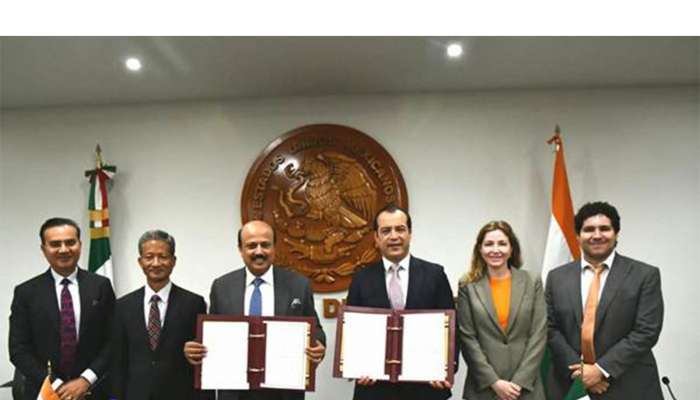
The recent India-Mexico trade pact is an outcome of such conditions. Analysing the global economic disposition of these two economies, one finds that both are major emerging powers of their region and strong voices of the Global South. With trade shifting away from Western-dominated routes, strengthening trade ties between these economies highlights the broader trend toward deeper South-South trade. To materialise it, in October 2026, India and Mexico signed the Terms of Reference for a Preferential Trade Agreement (PTA) between the two.
The logic behind the contract lies in a diplomatic as well as based on an urgency. On the diplomacy front, the pact is a way of strengthening the South-South cooperation between Global South giants. On the urgency factor, there are two push factors for the PTA. First, Mexico has implemented import tariffs (ranging from 5 percent to 50 percent) on over 1,400 product categories from countries with which it doesn’t have a trade agreement. This has made signing a PTA necessary to lower the tariff barriers for Indian exports. In April-September 2026, India exported about $1.41 billion of high-value tech goods to Mexico.
These shipments, including motor vehicles, auto components, two- and three-wheelers, aluminium, iron and steel, and steel products, represented around 41 percent of $3.45 billion in merchandise exports from India to Latin America, highlighting the magnitude of India-Mexico trade ties . The PTA helps in ensuring that India’s multi-billion-dollar exports in value-added sectors to Mexico remain competitive.
If the PTA isn’t in place, Indian automobiles, auto components, pharmaceuticals, engineering goods, and textiles stand to lose competitiveness vis-à-vis exports from countries that have FTAs with Mexico. Second, given the locational advantage of Mexico, through the Pact, India gets a stable entry point into the vast South American markets. Deepening ties with Mexico also helps India to widen access to North American-linked supply chains and industrial markets . As put by Rajesh Agarwal, India’s Commerce Secretary, the negotiations focus on “identifying mutually beneficial opportunities to expand trade, facilitate investment and strengthen supply chains, while leveraging the complementarities between the two economies” .
The Pact under negotiation also has a vast signalling effect for the Global South. It reflects a significant structural shift in international relations, envisaged by South-South cooperation.
The traditional trade model involves the Global South as an exporter of low-value primary products to the Global North, in exchange for high-value manufactured products, with implicit hierarchy and terms of trade in favour of the Global North. This is now contrasted by the emerging South-South Model, where Global South partners trade high-value goods with each other and, through increasing trade, build robust supply chains to safeguard themselves against Western dominance. This is highlighted in the agreement, which focuses on advanced sectors like automotive engineering, advanced electronics, and pharmaceuticals.
The signing has opened the doors for formal PTA negotiations covering market access, rules of origin, customs procedures, and trade facilitation between the two economies.
The agreement is characteristic of the phase of Global South economies that undertake trade in the high-tech sector and ensure a mutually beneficial trade ecosystem, independent of Western intervention. This ecosystem also helps in gaining strategic autonomy for emerging market nations and, in turn, reduces their over-reliance on single dominant markets.
Creation of robust supply chains through these bilateral ties ensures that economies are not impacted by the vagaries of external geopolitical shocks and the whims of the trade hegemons. Robust trade ties between the two stand to create opportunities to boost supply to Mexican manufacturers, thereby expanding production and developing investment partnerships for India .
The developing India-Mexico PTA framework also provides a stage to transition the long-standing bilateral diplomatic ties and camaraderie into a tangible and structured trade instrument, buttressed by business-to-business (B2B) engagements .
To summarise, with the PTA, Indian pharmaceuticals, engineering goods and auto components are expected to meet real demand in a Mexican market actively seeking alternatives to concentrated supply. Besides, as Mexico has vast export interests in India, it makes “mutual reciprocity” a key element of the agreement, a hallmark of durable South-South cooperation. The PTA is also expected to be processed quickly and structured in a manner that trade concessions are tailored where each sector is genuinely competitive. This Pact also sets an example of where the Global South sets the rules for itself, rather than following predefined rules of the West.