Wednesday 07 / October / 2026
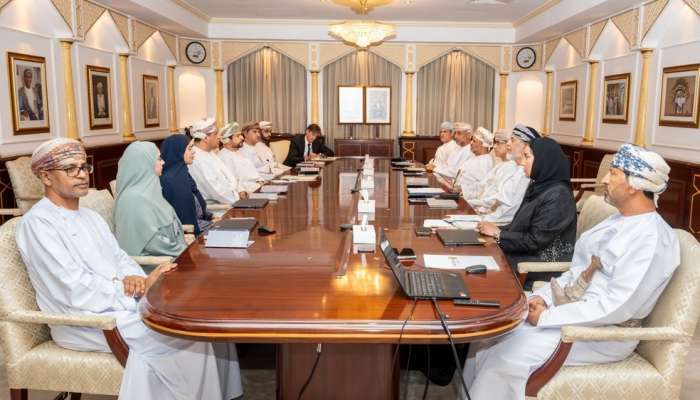
Muscat--- The joint committee between Sultan Qaboos University (SQU) and the Public Authority for Special Economic Zones and Free Zones (OPAZ) today held its second meeting in the University Council Hall.
The meeting was attended by HH Sayyid Dr. Fahd bin Al Julanda Al Said, SQU Vice-Chancellor and Qais bin Mohammed Al Yousef, OPAZ Chairman.
The committee discussed a set of topics on the meeting's agenda, which included following up on the recommendations of the committee's first meeting that have been activated, and the new topics raised by both sides relating to a set of joint initiatives and projects aimed at enhancing integration between education, training, scientific research and the economic zones sector, and strengthening the partnership between the two sides in line with the targets of Oman Vision 2040.
The meeting opened with a presentation delivered by Professor Dr. Salim bin Hamoud Al Harthy, Deputy Vice-Chancellor for Academic Affairs and Community Service, on the student training programme implemented during the past period in the Special Economic Zone at Duqm in coordination with the University, and the results it achieved in equipping students with the required practical experience.
The committee reviewed proposals in the field of training and qualification, including a proposal to expand student training programmes to encompass the sites of the Public Establishment for Industrial Estates (Madayn), alongside the Special Economic Zone at Duqm, and to examine the possibility of direct communication with the companies affiliated with the OPAZ to identify the challenges they face, contribute to finding solutions for them, and determine the skills required to qualify students for the labour market, thereby enhancing the alignment of the University's outputs with the needs of the sector.
In the field of studies and research, the committee reviewed a proposal submitted by the SQU Oman Studies Centre to study the relationship between special zones and free zones and local communities in the Sultanate of Oman, through documenting intangible cultural heritage and monitoring the social and cultural transformations in the surrounding areas, in a manner that contributes to achieving a balance between the requirements of economic development and the preservation of the cultural identity of local communities.
At the conclusion of the meeting, both sides affirmed the importance of continuing joint work and activating the proposed initiatives and recommendations in service of economic, research and community development in the Sultanate of Oman.