Sunday 25 / October / 2026
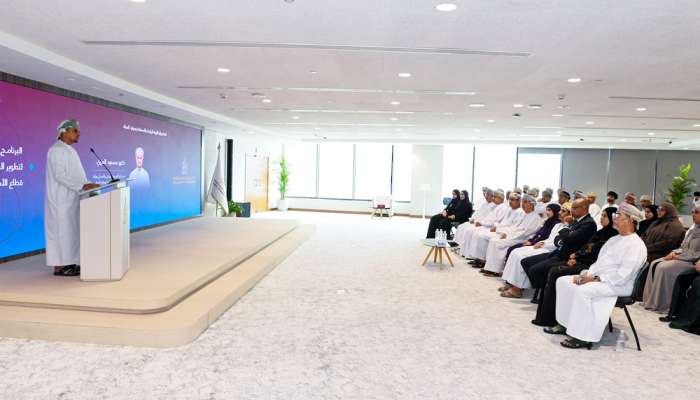
Muscat: The Royal Academy of Management, in partnership with the Ministry of Agriculture, Fisheries and Water Resources, has launched the National Leadership Development Programme in the Food Security Sector. The move aims to reinforce national efforts to build a sustainable and resilient food security system.
The programme launching ceremony was held under the auspices of Dr Saud Hamoud Al Habsi, Minister of Agriculture, Fisheries and Water Resources, and aims to develop and equip Omani leaders capable of leading this vital sector and enhancing its efficiency.
The programme is a strategic initiative focused on developing leaders involved in the national food security agenda and enabling them to adopt a strategic perspective that goes beyond the traditional concept of self-sufficiency. It seeks to build a more resilient and sustainable model based on anticipating risks, diversifying supply sources, and strengthening integration across sectors and stakeholders within the food security ecosystem.
The programme targets 35 leaders from the government sector, government-owned companies, the private sector, academic and research institutions, the banking sector, and civil society associations. Participants are required to have a minimum of 12 years of professional experience, including at least five years in leadership positions, and will be selected according to clear and rigorous criteria.
Dr. Fathiya Abdullah Al Rashdi, Assistant President for Programmes at the Royal Academy of Management, said that the programme represents a distinctive step towards preparing national leaders who can respond effectively to the rapid shifts and developments within the sector.
She added: “By developing capabilities in strategic thinking, risk anticipation, decision-making and building effective partnerships, we are strengthening the readiness of the food security ecosystem and transforming challenges into sustainable opportunities for growth.”
Dr. Masoud Sulaiman Al Azri, Director General of Agricultural and Fisheries Marketing at the Ministry of Agriculture, Fisheries and Water Resources, said that the programme marks an important step in developing national leaders equipped to navigate the evolving landscape and challenges of the food security sector, while strengthening its resilience and long-term sustainability.
He added that the next phase calls for closer collaboration across sectors and the strategic adoption of innovation, emerging technologies and artificial intelligence to enhance operational efficiency and reinforce the sector’s capacity to deliver Oman’s national food security objectives.
Maha Mohammed Al Habsi, Programme Supervisor, explained that the learning journey has been designed to combine theoretical knowledge with practical application, enabling participants to translate strategic concepts into field-based practice.
She said: “We have ensured that participants experience an integrated journey that combines dialogue, immersion and collaborative work, helping them develop practical solutions to existing challenges and strengthen their ability to lead the sector’s future projects.”
The programme is structured around three key dimensions: a strategic and intellectual dimension focused on reframing and building resilience; an investment and development dimension that strengthens investment thinking and the ability to balance national priorities with economic viability; and a field-based and integrative dimension focused on practical application, execution leadership and coordination across sectors.
The three-month learning journey comprises three learning modules, alongside applied field visits to key sites linked to the food security ecosystem, dialogue sessions with senior officials, decision-makers, and local and international experts, as well as a collaborative applied project through which participants will address one of the sector’s key challenges.
The programme covers nine integrated strategic themes: strategic reframing; investment discipline; strengthening competitive advantage; value and supply chains; immersion and field application; emerging technologies and innovation; governance and institutional integration; international expansion and partnerships; and strategic reserves and food health.
Through this integrated journey, the programme aims to enable participating leaders to develop a shared strategic language, formulate attractive investment opportunities, identify Oman’s competitive advantages, address vulnerabilities in supply chains, and lead innovation and digital transformation—contributing to the advancement of national food security towards greater sustainability and efficiency. -ONA