Friday 16 / October / 2026
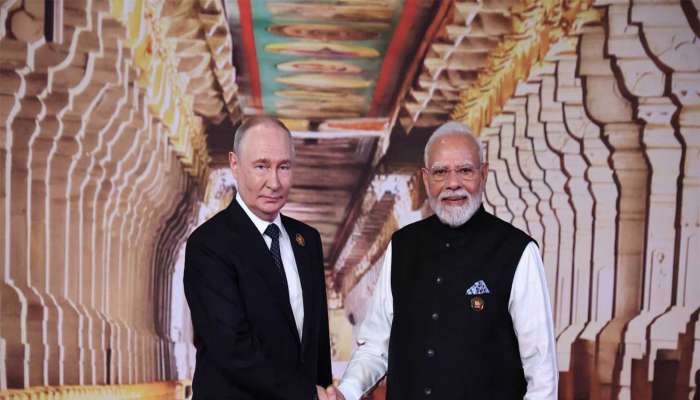
New Delhi: India and Russia are seeking to take their longstanding defence partnership beyond the traditional buyer-seller model, with technology transfer, joint production and the development of advanced military systems gaining greater prominence.
The shift comes as India expands its domestic defence manufacturing capabilities while continuing to operate a large inventory of Russian-origin equipment. The two countries are increasingly discussing arrangements under which more Russian-designed systems could be manufactured, upgraded or developed in India.
During Russian President Vladimir Putin’s visit to New Delhi ahead of the BRICS Summit on September 12-13, he and Prime Minister Narendra Modi discussed defence cooperation along with political, economic and energy ties. Defence issues included the future of the BrahMos missile programme, the S-400 air-defence system and Russia’s proposed Su-57 fifth-generation fighter for India.
The discussions were followed by a visit to Russia by Indian Army Chief General Dhiraj Seth from September 16 to 18, the first visit by an Indian Army chief to Russia in nearly eight years. During the visit, Seth held talks with senior Russian military officials on professional military cooperation, training, capability development and the sustainment and modernisation of Russian-origin equipment.
Russia remains an important source of military equipment for India, although its share of Indian arms imports has declined significantly. According to figures cited in recent reporting, Russian equipment accounted for about 40% of India's arms imports during 2021-25, compared with 51% in the previous five-year period.
At the same time, India has substantially expanded domestic defence production. Government figures show that nearly 65% of India's defence equipment is now produced domestically, compared with an earlier import dependence of around 65-70%. Defence production reached a record ₹1.78 lakh crore in 2025-26, while exports rose to ₹38,424 crore.
This changing industrial base is influencing the nature of India's engagement with Russia. Rather than simply purchasing finished systems, New Delhi is seeking greater localisation, production capabilities and access to technologies.
Su-57 and technology transfer
The Russian offer of the Su-57 fighter has emerged as one of the clearest examples of the evolving relationship. Russian officials have indicated that discussions include the possibility of local manufacturing and technology cooperation, although the precise terms remain under negotiation.
The development reflects a broader Russian effort to promote cooperation with India on production and technology rather than limiting the relationship to exports of completed platforms. Recent reporting has described technology transfer and joint production as central elements of Moscow's proposals.
For India, local production would fit its wider effort to strengthen domestic manufacturing and reduce dependence on imported defence equipment. For Russia, deeper industrial cooperation would preserve access to one of its longstanding defence partners while opening possibilities for joint development and exports.
BrahMos enters a new phase
The BrahMos supersonic cruise missile remains the most established example of such cooperation. Developed through an Indo-Russian joint venture, the programme has evolved considerably since its establishment, with India taking an increasingly important role in production, integration and development.
Russian officials recently proposed further upgrades to the missile, including additional capabilities intended to improve its effectiveness and competitiveness in international markets.
India is also considering changes within BrahMos Aerospace that would bring more engineering and research-and-development work in-house. The company has already expanded beyond its original role as a producer of a jointly developed missile, with BrahMos becoming part of India's growing defence export portfolio.
The two countries are also discussing the next generation of the missile and its potential joint production. The BrahMos programme illustrates how the relationship can move from Russian-origin technology toward increasingly Indian-led development and manufacturing.
Armoured vehicles and wider production
The same model is being explored in land systems. Russia has offered India the opportunity to jointly produce the T-90MS main battle tank, building on India's long experience with licensed production of the T-90 family.
The proposal includes local manufacturing and technology transfer, while India already has substantial domestic production capabilities for Russian-designed T-90 tanks.
Such arrangements could allow India to obtain newer Russian technologies while increasing the proportion of work performed by Indian industry.
Logistics cooperation expands
The relationship has also acquired a broader operational dimension through the Reciprocal Exchange of Logistics Support (RELOS) agreement signed in Moscow in February 2025.
The agreement establishes procedures for the movement of military personnel, warships and aircraft between the two countries and provides for reciprocal logistical support, including port services, repairs, refuelling and airfield support. It entered into force in January 2026 after ratification.
Under the arrangement, the two countries can simultaneously station up to 3,000 troops, five warships and 10 military aircraft in each other's territory for an initial five-year period, subject to the agreement's provisions. The pact also covers joint exercises, training and humanitarian assistance and disaster-relief activities.
The agreement adds a logistical framework to a defence relationship that has traditionally been centred on equipment procurement and military-technical cooperation.
A changing defence partnership
India's expanding defence-industrial base is gradually changing the structure of its relationship with Russia. While Russian-origin aircraft, tanks, missiles and air-defence systems remain important to India's armed forces, the emphasis is increasingly on what Indian industry can manufacture, modernise and develop domestically.
For Russia, this creates opportunities to retain a major defence partner through technology cooperation, joint production and potentially new export markets. For India, it provides another avenue for acquiring advanced technologies while pursuing its broader domestic manufacturing objectives.
The recent Modi-Putin discussions, the BrahMos modernisation proposals, the Su-57 offer, the T-90MS production proposal and General Seth's military engagement in Moscow point to a relationship that is increasingly being structured around co-development, localisation and technology sharing alongside conventional arms procurement.