Sunday 25 / October / 2026
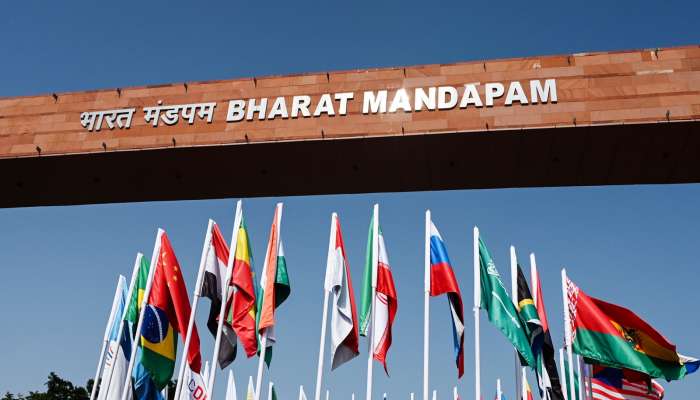
NEW DELHI: BRICS leaders will gather in the Indian capital on September 12-13 for a two-day summit as the expanded grouping seeks to strengthen its influence in global political and economic affairs while navigating differences among its increasingly diverse membership.
The 18th BRICS Leaders’ Summit, hosted by Indian Prime Minister Narendra Modi, comes at a significant moment for the grouping, which has expanded well beyond its original five-member format to include major economies and influential states from Asia, Africa, the Middle East and Latin America.
Russian President Vladimir Putin, Chinese President Xi Jinping and Iranian President Masoud Pezeshkian are among the leaders expected to attend the summit.
South African President Cyril Ramaphosa, Belarusian President Alexander Lukashenko, Egyptian President Abdel Fattah el-Sisi, Kazakh President Kassym-Jomart Tokayev and Indonesian President Prabowo Subianto are also expected in New Delhi.
The expanded BRICS membership comprises Brazil, China, Egypt, Ethiopia, India, Indonesia, Iran, Russia, Saudi Arabia, South Africa and the United Arab Emirates.
The grouping has also established a partner-country framework that includes Belarus, Bolivia, Kazakhstan, Cuba, Malaysia, Nigeria, Thailand, Uganda, Uzbekistan and Vietnam.
Malaysian Prime Minister Anwar Ibrahim, Thai Prime Minister Anutin Charnvirakul and Ethiopian Prime Minister Abiy Ahmed are among the partner-country leaders expected to attend. Cuba, Nigeria and Uzbekistan are likely to be represented by their presidents, Miguel Diaz-Canel, Bola Tinubu and Shavkat Mirziyoyev.
UN Secretary-General Antonio Guterres is also expected to participate.
Brazilian President Luiz Inacio Lula da Silva is expected to be represented by Foreign Minister Mauro Vieira, while the UAE is expected to send Abu Dhabi Crown Prince Sheikh Khaled bin Mohamed bin Zayed Al Nahyan in place of President Sheikh Mohamed bin Zayed Al Nahyan.
Conflict and global economy
Trade, development financing and reform of international institutions are expected to remain central to the summit agenda. But geopolitical tensions, particularly the conflict involving Iran and the United States and its wider economic consequences, are likely to feature prominently in discussions.
The conflict has heightened concerns over energy security and disrupted economic calculations across global markets, with Asian economies particularly exposed to energy and shipping disruptions.
Iran could seek language in the summit declaration reflecting its position on the conflict. However, reaching consensus could prove difficult given the diversity of political positions within BRICS and the group's requirement for agreement among members on major statements.
The issue will therefore provide a test of BRICS’ ability to present a common position on a major international crisis while accommodating competing national interests.
India-China equation
The summit could also offer an important setting for India and China to manage their complicated bilateral relationship.
If Xi attends, it would mark his first visit to India since his 2019 informal summit with Modi. The two countries are among the world's largest economies and remain key members of BRICS, but their relationship continues to be affected by unresolved border and sovereignty disputes.
The BRICS framework has nevertheless provided an avenue for sustained engagement between the two countries.
Eerishika Pankaj of Australia's Lowy Institute has argued that BRICS and the India-China strategic dialogue function as institutional mechanisms that allow the two sides to maintain communication despite persistent differences.
“Cooperation and unresolved sovereignty disputes coexist,” Pankaj wrote, suggesting that BRICS should be viewed as a mechanism for maintaining dialogue rather than evidence that India and China have resolved their disagreements.
This dynamic is likely to remain relevant as the expanded grouping attempts to balance its ambitions for greater global influence with the differing strategic priorities of its members.
Reform of global institutions
Reform of the international financial and political system is another longstanding BRICS priority.
The grouping has repeatedly called for changes to institutions such as the United Nations, International Monetary Fund and World Bank to give greater weight to emerging and developing economies.
The issue reflects a broader BRICS argument that global governance structures created decades ago no longer adequately reflect the distribution of economic and political power.
For India, the summit also provides an opportunity to reinforce its role as a bridge between developed and developing economies while advancing its priorities on development, technology, trade and global governance.
De-dollarisation remains on agenda
The use of national currencies in trade and finance is expected to remain another important area of discussion.
BRICS members have increasingly explored local-currency settlements as a way to reduce transaction costs and exposure to fluctuations in major international currencies, particularly the US dollar.
Egyptian Prime Minister Mostafa Madbouly said last year that BRICS members were increasingly using local currencies for bilateral financial transactions as part of efforts to strengthen economic cooperation and reduce dependence on foreign currencies.
However, the grouping has stopped short of creating a common BRICS currency, despite repeated speculation and discussion about the possibility.
The New Development Bank, established by BRICS, has meanwhile made local-currency financing a strategic priority.
Its 2024 report showed that 43.5% of its approvals that year were denominated in member-country currencies, mainly the South African rand and Chinese yuan.
The shift reflects a broader effort to build alternative channels for trade and development finance without attempting to immediately replace the dollar as the dominant global currency.
From BRIC to a larger global grouping
The New Delhi summit also highlights how dramatically BRICS has evolved since its creation.
BRIC was formalised in 2006 when Brazil, Russia, India and China began coordinating as an emerging-economy grouping. Their first leaders’ summit was held in Yekaterinburg, Russia, in 2009.
South Africa joined in 2010, transforming BRIC into BRICS.
A major expansion followed, bringing several countries from the Middle East and Africa into the grouping, with Indonesia becoming the latest full member.
According to BRICS figures, the expanded grouping now represents about 49.5% of the world's population, 40% of global GDP and 26% of global trade.
Its growing economic and demographic weight has strengthened calls for a greater role for emerging economies in international decision-making.
At the same time, the expansion has made consensus more complicated. BRICS now brings together countries with different political systems, economic structures, foreign-policy priorities and relationships with the United States and other major powers.
The challenge for the grouping is therefore not simply expansion but converting its growing collective weight into sustained cooperation.
BRICS describes itself as a platform for consultation and cooperation on global and regional issues, particularly international political and economic governance.
The previous BRICS summit was held in Rio de Janeiro, Brazil, in 2025, while China is scheduled to host the 2027 summit.
The New Delhi meeting will consequently be closely watched for signs of whether the expanded BRICS can move beyond its role as a forum for coordination and emerge as a more cohesive force in shaping the global order.