Thursday 22 / October / 2026
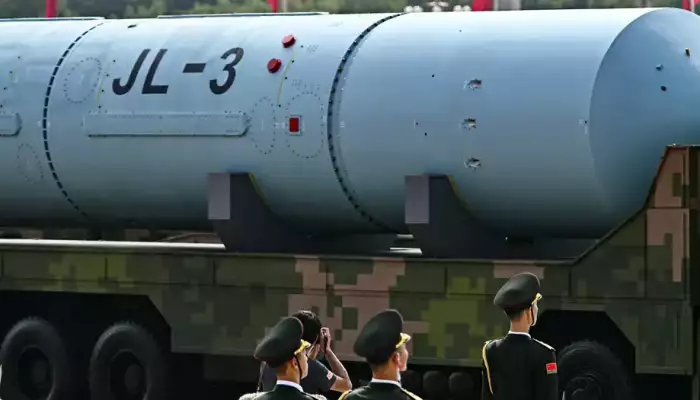
The Chinese Navy conducted a missile test in the South Pacific, with state media reporting that a nuclear submarine fired a missile carrying a dummy warhead into international waters.
The test quickly drew harsh criticism from US allies in the Pacific. Australia's Foreign Minister Penny Wong said the Chinese test was destabilizing for regional security. Japan called on China to reconsider its actions.
New Zealand said it does not want China to use the South Pacific as a testing ground for missiles. "We are deeply concerned about China's tests of nuclear-capable weapons in the South Pacific," Foreign Minister Winston Peters said in Wellington
During the Cold War, the US tested numerous nuclear weapons around the South Pacific's Bikini Atoll, which today is part of the Marshall Islands. Since World War II, the US has dominated the postwar security architecture in the Pacific region.
What do we know about China's missile test?
China's military buildup is now challenging this construct. Although official media have not released any details about the test, nationalist military experts are speculating on Chinese social media about how powerful the tested missile might have been.
"It is a submarine-launched intercontinental ballistic missile of the Julang (JL)-3 series," wrote Lieutenant Colonel Zhang Junshe a researcher with the People's Liberation Army (PLA) Naval Military Academic Research Institute.
The Julang-3, which means "Giant Wave-3" in English, is currently still under development.
It is said to have a maximum range of 12,000 kilometers (7,400 miles) and can carry multiple nuclear warheads. So far, three successful tests have been reported between 2018 and 2019.
"The target of this missile is not combat troops on the front lines, but strategic targets such as command centers, military bases, or energy infrastructure," Zhang wrote in his blog.
The "Giant Wave-3" is believed to have been launched from a Type 094 Jin-class nuclear-powered submarine. With a full crew of 120 sailors, the 135-meter-long submarine can sustain a submerged crew for at least 70 days. Currently, the Chinese Navy has six Type 094 submarines in service.
Zhang said it cannot be ruled out that a modified submarine was involved.
According to the Nuclear Threat Initiative, a Washington-based think tank, China operates an additional 59 nuclear-powered attack submarines in addition to the Jin-class submarines.
China's nuclear arsenal has roughly tripled since 2020, from around 200 warheads to more than 600, with the Pentagon projecting over 1,000 by 2030. Submarines matter within that arsenal because they constitute its survivable leg: hidden, mobile, difficult to target in a first strike. Set beside the 2024 land-based test, this launch reads as part of a pattern in which Beijing is increasingly willing to publicly validate both legs of its arsenal, rather than developing them in secrecy. Set against China's wider submarine build-out, the test looks less like a one-off demonstration and more like a deliberate step toward continuous at-sea deterrence, the kind of standing, always-on undersea patrol long practised by the United States, France and the United Kingdom.
The timing reinforced the signal. The launch coincided with the opening of the China-Russia 'Joint Sea 2026' exercise, and it fell on the same day Australia and Fiji signed a new mutual defence pact. Beijing's notification to Tokyo arrived roughly ninety minutes ahead of launch, sufficient to satisfy the letter of advance notice and little more, in what is being described as the first known full-range Chinese SLBM flight test into the Pacific.
Beijing's own account
China's own reporting is worth reading closely, since it reveals what Beijing wanted the launch to communicate. State news agency Xinhua carried the navy's statement within an hour of the launch, calling it routine annual training that complied with international law and targeted no country. State-run Global Times went further, quoting a military affairs commentator who said the missile, believed to be the JL-3, had "become the backbone of the sea-based nuclear deterrent system" with a range exceeding 10,000 kilometres. China's Foreign Ministry spokesperson later said Beijing hoped other countries would avoid overinterpreting the test, while its defence ministry maintained that China's arsenal remains at the minimum level it deems necessary and that it has no intention of entering a nuclear arms race. Beijing's messaging pulls in two directions at once: reassurance abroad, and pride in capability at home.