Tuesday 20 / October / 2026
By Ayushi Agarwal | May 06, 2026 10:39 (GMT+4)
New Delhi: The India-New Zealand Free Trade Agreement (FTA) is a major step forward for the two countries with strategic cooperation in trade, education and Indo-Pacific security. It is another leap forward in setting global trade following US President Donald Trump’s trade war declaration last year.
The two countries have had good relations for decades. As the Consulate General of India in Auckland put it in a bilateral brief, “India and New Zealand (NZ) have historically shared close and cordial ties. Similarities such as membership of the Commonwealth, common law practices and pursuing shared aspirations of achieving economic development and prosperity through democratic governance systems for diverse communities in both countries … provide an excellent backdrop for deepening the friendly ties. Tourism and sporting links, particularly in cricket, hockey and mountaineering, have also played a significant role in fostering goodwill between the two countries.”
However, trade between the two countries has been limited, but has been growing steadily in recent years. Now the FTA aims to boost it further and turn their relationship into a stronger and longer-term strategic partnership.
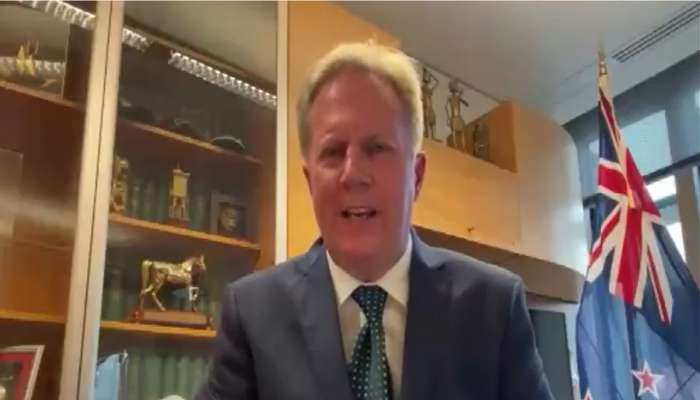
New Zealand Trade and Investment Minister Todd McClay stated that the two-way trade between India and New Zealand is poised to double within a few years as both nations finalize a high-quality Free Trade Agreement (FTA).
The Minister noted that the FTA caters to New Zealand's consumers who seek high-quality goods and services, which, he mentioned, are readily available in the Indian market. The New Zealand government is committed to promoting up to USD 20 billion in investment into India over the next 15 years.
To facilitate this flow of capital, the Indian government agreed to establish a special New Zealand "single desk" to streamline and accelerate investment clearances. "The Indian government has agreed to set up a special New Zealand desk or single desk to help clear those investments, and so they can take place a lot more quickly. It's easier for New Zealanders to invest," he said.
The Minister emphasized that the agreement provides immediate benefits for Indian exporters. From the first day of the pact's implementation, every export from India to New Zealand becomes completely tariff-free.
"As an example, there is a New Zealand company that manufactures beds and sells them in the New Zealand market. They have announced a USD 200 million factory they will build in India to produce beds for the Indian market, but actually to export around the region," McClay highlighted.
McClay also noted that currently, India represents only one per cent of New Zealand's trade, having not even penetrated the latter's top 20 trading partners yet.
"I think you will see our two-way trade double within just a few years. The reason for that is we are starting from a very modest amount of trade. Only about 1% of what New Zealand sells around the world goes to India. You're not in our top 20 trading partners yet. I think you will see in both directions, India's storm up the statistics and become a very important and reliable partner for New Zealand," McClay said.
McClay views the agreement as a vital source of stability during a period of global trade volatility and rising tariffs in other major markets. He described the FTA as a "beacon" of certainty for the business community, taking away risk in an uncertain world.
"The India-New Zealand Free Trade Agreement stands out as a beacon, a very bright light at a time of international trade uncertainty when governments decide they want to work together and they trust each other, very good things can happen to the business community. So for anybody listening who is uncertain, come to New Zealand and come to India, bring your manufacturing and actually you will be able to rely upon not only the New Zealand India free trade agreement, but the other agreements New Zealand has," McClay stated.
The Minister also mentioned a recent partnership between a New Zealand financial services tech firm and Axis Bank. This collaboration involves bringing specialized technology to India to improve banking reliability and service delivery, with the New Zealand firm establishing a local office and hiring both Indian and New Zealand staff.
While the focus remains on economic growth, the Minister underscored that the relationship also prioritizes people-to-people connections, culture, and sport. He described the agreement as a modernizing step for two countries with a strong historical bond, offering a dependable framework for future cooperation in areas such as global supply chains and shipping.
"What the New Zealand and Indian government have done in negotiating the trade agreement and signing it is said to the world, we have made commitments to each other, rights and obligations, and we intend to honor them. In such an uncertain world, this trade agreement gives you certainty and it takes risk away," McClay said.
The Minister emphasized that the deal represented a significant achievement for both governments, who worked around the clock to complete negotiations in record time. The agreement is expected to enter into force later this year, marking a strategic shift in the bilateral relationship.
Duty-free access for Indian exports
A defining feature of the agreement is the provision of 100% duty-free access for Indian exports to New Zealand. This is expected to significantly enhance the competitiveness of Indian goods by removing tariff barriers that previously increased costs.
Sectors such as textiles, pharmaceuticals, engineering goods, machinery, and processed food products are likely to see immediate gains.
For India’s micro, small, and medium enterprises, the agreement opens access to a stable, high-income market with strong purchasing power. As a result, both the volume and diversity of Indian exports are expected to expand.
The agreement is equally important for New Zealand, which gains improved access to one of the fastest-growing major economies in the world. India’s expanding middle class, rapid urbanisation, and rising consumer demand create opportunities for New Zealand’s strengths in agriculture, horticulture, timber, wool, and premium food products.
Additionally, New Zealand firms can expand their presence in agri-technology, education, and sustainability solutions. This complementary trade structure – India’s manufacturing and services capacity alongside New Zealand’s agricultural and technological expertise – provides a strong basis for long-term engagement.
While trading in goods will benefit from tariff elimination, the most significant long-term gains are likely to come from services trade. The agreement includes commitments across sectors such as information technology, finance, education, telecommunications, and professional services.