Saturday 03 / October / 2026
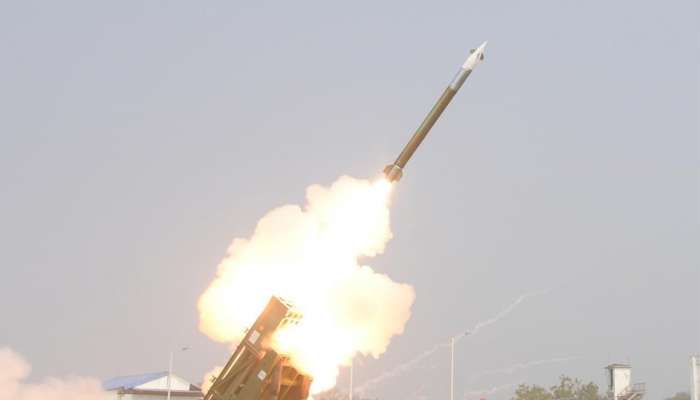
New Delhi: The maiden flight test of Pinaka Long Range Guided Rocket (LRGR 120) was conducted successfully at the Integrated Test Range in Odisha's Chandipur in December 2025.
The rocket was tested for its maximum range of 120 kms, demonstrating all in-flight manoeuvres as planned. The LRGR impacted the target with textbook precision.
All the deployed range instruments tracked the flight throughout its trajectory. This rocket is designed by the Armament Research and Development Establishment in association with the High Energy Materials Research Laboratory, with support from the Defence Research and Development Laboratory and the Research Centre Imarat.
The flight trial was coordinated by ITR and Proof & Experimental Establishment. The LRGR was launched from the in-service Pinaka launcher, demonstrating its versatility and providing launch capability of Pinaka variants of different ranges from the same launcher.
Defence Minister Rajnath Singh has congratulated DRDO on the achievement. He stated that the successful design and development of long-range guided rockets will boost the capabilities of the Armed Forces, terming it a game-changer.
The Pinaka Multiple Launcher Rocket System (MLRS) is a long-range artillery weapon developed by the Defence Research and Development Organisation (DRDO).
Known for its rapid response and precision, the Pinaka system enhances the Indian Army's capability in modern warfare.
One of the biggest success stories among Indigenous weapon systems, the Army is fully backing the missiles, as Chief of Army Staff Gen Upendra Dwivedi has already made clear that, as soon as longer-range versions of the Pinaka are ready, the force might drop plans for other alternate weapons.
The Pinaka system was originally developed as a Multi-Barrel Rocket Launcher (MBRL) designed for short-range area saturation in support of ground manoeuvres. The extended-range Pinaka LRGR-120, however, represents a clear change in how India intends to use this system. Instead of employing it primarily for saturated strikes against wide area targets, India is now assigning Pinaka the role of engaging targets beyond the immediate battlefield. This change in employment alters the function of Pinaka from tactical to operational-level relevance.
Technical details released by the DRDO after the test indicate that the rocket incorporates a guidance system and control features intended to maintain accuracy throughout its flight. The DRDO confirmed that the rocket executed all planned in-flight manoeuvres and was continuously tracked by range instrumentation until impact.
These disclosures reinforce that Pinaka LRGR-120 is designed for precision engagement rather than an area weapon, marking a substantive departure from earlier unguided variants of the system.: Former DRDO scientist Doctor Ravi Gupta on Tuesday highlighted the strategic and technological significance of India’s Pinaka multi-barrel rocket launcher system, describing it as a transformative achievement for the country’s defence ecosystem and a major boost for the indigenous industry.
Speaking to ANI, Dr Gupta said the Pinaka system marked a historic shift in India’s defence manufacturing journey, as it became the first defence system to be produced with the participation of private industry.
“The Pinaka multi-barrel rocket launcher system is significant in many ways. It was the first defence system to be manufactured by private industries in the country. In 2001, under the leadership of Prime Minister Atal Bihari Vajpayee, for the first time in the history of independent India, the participation of private industries in the defence sector was approved. This proved to be a game-changer, and leveraging this, DRDO collaborated with the private sector to have it produced by private industries,” he said.
Dr Gupta recalled that even during the Kargil War, when the system was still under development, it had demonstrated its potential on the battlefield.
“Even during the Kargil War, when the Pinaka was not yet fully developed, it demonstrated its capabilities. Since then, it has made a very significant contribution to the army,” he added.
Highlighting the cost-effectiveness of the system, the former DRDO scientist said multi-barrel rocket launchers offer a strategic advantage over guided missiles in terms of affordability, while still delivering formidable firepower.
“Moreover, the advantage of a multi-barrel rocket launcher is that it is less expensive. Compared to our guided missiles, their cost is significantly lower, although their accuracy is not as high as that of guided missiles,” he said.
Dr Gupta further noted that recent technological advancements have significantly enhanced the system’s capabilities.
“Now, the recently developed 120-kilometre range multi-barrelled long-range rocket system has an accuracy comparable to a guided missile, but at a much lower cost. A large area of enemy territory can be destroyed in just a few minutes,” he said.
Emphasising the system's battlefield relevance, he added that its extended range gives India a decisive tactical advantage.
“A 120-kilometre range can prove very decisive for a tactical weapon on the battlefield, and this will give our armed forces great strength and power. Even though it is a tactical weapon, when it is used in large quantities by our armed forces in battle, it can prove very decisive in the war,” he said.
Dr Gupta also highlighted the programme's broader industrial impact, noting its role in strengthening India’s defence manufacturing ecosystem.
“Another important aspect is that since it was developed in collaboration with the private sector, it will give a significant boost to our industries. It will help in expanding our defence industries,” he added.
The command-and-control implications of employing long-range guided artillery are also significant. Precision strikes require accurate targeting information, rapid coordination, and timely delegation of launch authority on both political and military levels. During a crisis, the delegation of authority to field commanders could increase the risk of inadvertent escalation. India’s refusal for dialogue with Pakistan to resolve outstanding disputes and discuss further Confidence Building Measures (CBMs) makes such precision-strike weapons highly concerning for the regional stability.
Pinaka LRGR-120 test also signals a continuing trajectory in India’s military force advancements. Statements associated with the programme indicate plans for further extending the range and accuracy of Pinaka. Each enhancement has the potential to broaden India’s conventional strike envelope and may compel Pakistan to adjust its own force posture, perpetuating a cycle of competitive military development.
This dynamic poses a serious threat and can undermine strategic stability in South Asia. Unlike nuclear weapons, which are governed by established deterrence logic, long-range conventional systems operate in a grey zone where thresholds are less clearly defined. Their use creates uncertainty regarding intent, scale, and escalation control, particularly during fast-moving crises.
The Indian test of the Pinaka LRGR-120 is not a routine undertaking. It reflects a deliberate effort to reconfigure rocket artillery from an area-saturation weapon to a long-range guided strike system shaped by India’s defeat in the May 2025 confrontation. By seeking conventional options that avoid the nuclear risks, India is attempting to create space for limited scale conflict under the nuclear threshold, which potentially increases the risk of miscalculation and crisis instability. Without transparency, restraint, and meaningful CBMs, such developments make future conflicts in the region more dangerous and less predictable.