Monday 19 / October / 2026
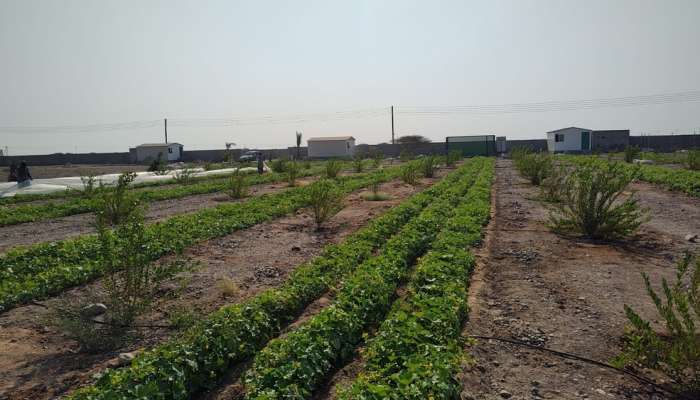
Sohar: The Al-Uwaynat area projects in the Wilayat of Sohar, North Al Batinah Governorate, serve as a living model of the transition toward investment-driven agriculture that contributes to reducing imports and raising self-sufficiency rates for fresh agricultural crops.
These projects are part of the efforts undertaken by the Ministry of Agriculture, Fisheries and Water Resources, in collaboration with the private sector, across various governorates of the Sultanate of Oman.
In a step that reinforces North Al Batinah Governorate's position as a primary food basket for the Sultanate of Oman, the Al-Uwaynat area in Sohar is witnessing notable agricultural activity through the implementation of nine integrated investment projects spanning approximately 100 acres. These projects aim to support the national food security system, with total investments estimated at OMR2.3 million.
Mohammed Said Al Maamari, Head of the Palm and Agricultural Production Section at the Directorate General of Agriculture, Fisheries and Water Resources in North Al Batinah Governorate, stated in a statement to Oman News Agency that the nine investment projects in Al-Uwaynat are part of efforts to boost investment in vital sectors and enable investors to contribute to strategic projects that support food security and achieve sustainable economic development. He emphasised that these projects represent promising investment opportunities, reflecting the commitment of relevant authorities to strengthening partnerships with the private sector.
He added that the Ministry of Agriculture, Fisheries and Water Resources continues to offer further investment opportunities throughout the current year through the "Tatweer" platform of the Ministry of Housing and Urban Planning in North Al Batinah Governorate, thereby contributing to the goals of Oman Vision 2040 and enhancing food security in the Sultanate of Oman.
He explained that these projects rely on a strategic combination of open-field cultivation and modern greenhouse technologies to ensure year-round production and meet local market demand. The crop distribution across these projects includes "sustainable fruit crops," focusing on cultivating premium varieties of mango, lemon, and fig; "seasonal crops," utilising extensive areas for growing cantaloupe and honeydew melon, which have already begun supplying local markets with abundant quantities of competitively high-quality produce; and "protected agriculture," as a significant number of investors and farmers in Al-Uwaynat have adopted greenhouse technologies to produce essential vegetables such as tomatoes, peppers, and cucumbers, ensuring protection from climatic fluctuations and high-quality output.
Al Maamari affirmed that these projects, valued at OMR2.3 million, exemplify the effective partnership between the private sector and government initiatives aimed at revitalising the agricultural sector. He noted that their significance extends beyond financial returns to include the creation of direct and indirect employment opportunities and the adoption of advanced irrigation and smart farming techniques that ensure the sustainability of water resources in the Wilayat of Sohar.
Meanwhile, Sarhan Said Al Muqbali, an investor in the Al-Uwaynat area stated that his project is one of the successful ventures in the field of food security, receiving significant attention and tangible support from the Ministry of Agriculture, Fisheries and Water Resources. He noted that the land area under investment spans 10 acres, where various types of vegetables such as tomatoes, cucumbers, eggplants, leafy greens, and fruits including mangoes are cultivated.
For his part, Yousuf Khamis Al Isaee, an investor in a project within the Al-Uwaynat area said that his project began with the cultivation of 200 local lemon trees and 300 mango trees of various commercial varieties, in addition to cultivating a cantaloupe field across a land area of 10 acres.
He affirmed that model farming projects contribute to enhancing food security by achieving a degree of self-sufficiency for certain target crops in commercial fields, supplying the market with high-quality local vegetable and fruit products, providing a source of income for farm owners and workers, and equipping farmers with the skills and knowledge required to manage and sustain these fields.