Sunday 05 / April / 2026
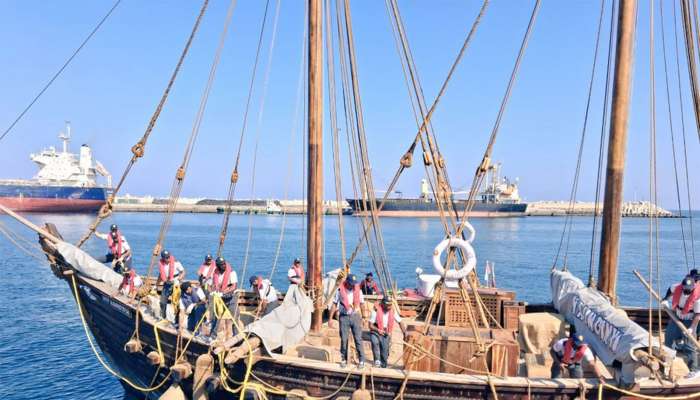
New Delhi: As Italian Prime Minister Giorgia Meloni arrived in Muscat for an official visit, the Omani capital was also welcoming the INSV Kaundinya, following a historic 18-day voyage from Gujarat to Oman. Two parallel arrivals — one political, the other maritime — converged in the same place and moment, projecting onto the Indian Ocean a narrative that bridges memory and strategy, past and future.
India's engagement with the Indo-Mediterranean and with routes such as the India–Middle East–Europe Economic Corridor (IMEC) is not confined to modern infrastructure or contemporary sea lanes. There is also a cultural and symbolic dimension that reaches deep into antiquity, adding historical depth to present-day strategic choices. The INSV Kaundinyasits squarely in this space: not merely a naval unit, but a living reconstruction of India's maritime heritage.
Inspired by fifth-century murals in the Ajanta caves depicting stitched-plank vessels, the ship was conceived as a bridge between modern India and its pre-industrial oceanic past — long before engines and steel hulls. The initiative was championed by Sanjeev Sanyal, economist and historian and a member of the Prime Minister's Economic Advisory Council, with the explicit aim of restoring visibility to India's ancient seafaring tradition within today's global narrative.
Unlike modern ships, the Kaundinya was built without nails or metal fastenings. Wooden planks were hand-stitched using natural coconut-fiber ropes and sealed with organic resins, following techniques preserved for centuries along India's coasts — particularly in Kerala. Ancient craftsmanship was thus combined with modern naval engineering, producing continuity rather than nostalgia.
The project emerged from a three-way collaboration involving India's Ministry of Culture, the Indian Navy, and Goa-based Hodi Innovations (OPC) Pvt Ltd. Keel-laying in September 2023 marked the beginning of nearly two years of work, complicated by the absence of surviving technical blueprints. Designers relied on iconography, historical maritime texts, and hydrodynamic tests conducted at IIT Madras to ensure the vessel's seaworthiness in open waters.
Launched in February 2025, the ship was formally inducted into the Indian Navy on 21 May 2025 at Karwar naval base in Karnataka. Its name recalls Kaundinya I, the legendary Indian navigator believed to have reached Southeast Asia, forging enduring cultural links — a reference that reinforces the project's long-term horizon.
The Kaundinya's first international voyage began on 29 December 2025 from Porbandar, Gujarat, bound for Muscat. The route traced ancient commercial paths linking the Indian subcontinent to the Arabian Peninsula long before colonial shipping reshaped global trade. Porbandar is also the birthplace of Mohandas Karamchand Gandhi, adding another layer of symbolism to a journey that intertwines history, identity, and diplomacy.
Throughout the crossing of the Arabian Sea, Sanyal shared regular updates on social media, describing the rhythms of sail navigation, shifting winds, and the daily challenges of a voyage that echoes experiences from over two millennia ago. One particularly evocative moment came with the distant sighting of a modern aircraft carrier — a stark visual reminder of how layers of maritime power coexist on the same horizon.
The ceremonial arrival in Muscat, attended by local and diplomatic authorities, therefore carried meaning well beyond historical commemoration. Oman has long been a central node in Indian Ocean networks and remains a contemporary crossroads for diplomacy, commerce, and maritime security. Against this backdrop, Meloni’s simultaneous presence added a further strategic dimension.
If the Kaundinya embodies India’s millennia-old maritime story, Meloni represents Italy’s forward-looking trajectory. As the country’s first woman prime minister, she has repositioned Rome as a more assertive actor in Europe and across the wider Mediterranean, with a growing focus on the Indo-Pacific. In Oman, India and Italy were symbolically brought together as complementary pillars of the Indo-Mediterranean — a space that is no longer merely geographic, but increasingly strategic.
This convergence was not the result of careful choreography, but of meaningful serendipity. At a time of heightened global instability, the Kaundinya’s voyage serves as a reminder that the seas — once bridges of exchange and connection — continue to shape international relations. Between historical memory and strategic projection, the Indo-Mediterranean once again tells an ancient story that remains strikingly relevant today.