Thursday 22 / October / 2026
The world's most populous country, India, and the 27-nation European Union announced on Tuesday that they have reached a free trade agreement to deepen economic and strategic ties.
EU chief Ursula von der Leyen described the deal as the "mother of all deals" that could affect as many as 2 billion people.
The deal is expected to double EU exports to India by 2032 by eliminating or reducing tariffs on 96.6% of EU goods entering the Asian nation, the European Commission said. The accord will bring down especially high import taxes for European wine and cars.
In turn, the EU will cut tariffs on 99.5% of goods imported from India over seven years. Provided that the EU Parliament ratifies the new trade deal, a formal signing of the document is expected later this year.
India, EU sign new defense trade pact
India and the EU also agreed on a framework for deeper defense and security cooperation, and a separate pact aimed at easing mobility for skilled workers and students, signaling their partnership extends beyond commerce.
EU foreign policy chief Kaja Kallas said that the pact also established an annual security and defense dialogue, with the first meeting to take place this month.
"As the global order shifts, the EU will continue to deepen its diplomatic and economic ties across the world. Strong partnerships multiply our strength," she said.
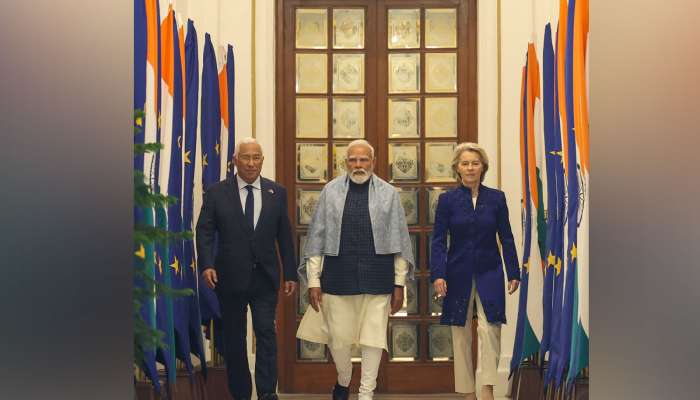
The friendship between top officials from both the Indian delegation and the EU delegation was apparent even before the bosses — European Commission President Ursula von der Leyen, European Council President Antonio Costa and Indian Prime Minister Narendra Modi — arrived at the Kailash Hall in Hyderabad House.
EU's foreign policy chief Kaja Kallas was seen sharing a moment of laughter with Indian Foreign Minister S. Jaishankar and the familiarity appeared indicative of all the hard work and multiple rounds of negotiations that they have held over the course of the last year, a year where it became clear that there was a need for urgency. The chemistry in the room was unmistakable.
I was struck by Ursula von der Leyen's deep knowledge of Indian culture — evident in her reference to auspicious Hindu festivals such as Makar Sankranti and Uttarayan.
She said, "It is the beginning of Uttarayan, the sun's northward journey. From darkness to light. From stillness to growth. From what was to what can be. That is what makes our Summit so unique and timely. The time is ripe for renewal. For fresh momentum. And for opening a new chapter in EU-India friendship. And this is exactly what we have achieved today, together."
Also noteworthy was von der Leyen's choice of attire as she attended the Republic Day parade. She wore an Indo-Western attire called an achkan, a long buttoned coat, with golden brocade.
Modi invoked Antonio Costa's Indian heritage and told the room full of journalists and delegates that he is famously known as Lisbon's Gandhi. Antonio has Indian roots. His father's family comes from Goa in India. And that would have surely helped when the two sides were negotiating hard to make this deal a reality.