Muscat--- The Environment Authority today held a media conference to present the environmental yield of the most consequential projects, initiatives, and performance indicators for the Sultanate of Oman.
The review detailed the accomplishments secured throughout the Tenth Five-Year Plan (2021-2025), underscoring the nation’s steadfast commitment to environmental stewardship and the advancement of sustainability.
The Authority illuminated the Sultanate of Oman's remarkable progress on the global stage, achieving a historic ascent of 94 positions in the Environmental Performance Index to attain 55th rank worldwide and second place regionally within both the Gulf and the Arab world.
This distinguished achievement was further crowned with the Arab Excellence Award, bestowed in recognition of the Authority’s pioneering endeavors in sustainability and environmental guardianship.
It was detailed that 589 environmental projects were executed over the preceding five-year period.
These encompassed a suite of strategic initiatives designed to fortify sustainable development. By 2025, a total of 32 natural reserves have been proclaimed across Oman, comprising 13 terrestrial, 5 marine, and 13 integrated terrestrial-marine sanctuaries, elevating the total protected realm to 17,839.57 square kilometers.
The National Initiative to Cultivate Ten Million Trees has seen the planting of 856,142 wild trees, the distribution of 652,241 wild tree seeds, and the sowing of a further 59,176,777 seeds. Concurrently, mangrove forest expansion efforts resulted in the cultivation of 11,386,391 mangrove trees.
Cumulative vegetative cover development reached 10,825,917 trees, actively enhancing air quality and contributing to the global fight against climate change. In a decisive move to safeguard native biodiversity, 1,631,498 invasive birds were culled to curb their threatening proliferation.
A network exceeding 60 ambient air quality monitoring stations has been established across the Sultanate of Oman’s governorates, ensuring comprehensive surveillance of atmospheric purity. The "Environmental Guardians" initiative educated 99,174 citizens, deterred 70,642 individuals from harmful ecological practices, rescued 29,398 disoriented hatchling turtles, and removed 2,572 vehicles from protected green spaces in a concerted campaign against pollution.
The Authority’s scholarly contribution included the publication of 22 papers in esteemed, peer-reviewed scientific journals, amplifying its role in environmental research and knowledge exchange. Regulatory diligence manifested in the issuance of 103,382 environmental permits and licenses, complemented by 203,912 field and periodic inspections for wildlife protection.
Enforcement actions recorded 4,721 environmental violations, while the Environmental Emergency Center received 367 reports. Public outreach flourished through 4,255 awareness seminars and campaigns, and the natural reserves welcomed 550,286 visitors.
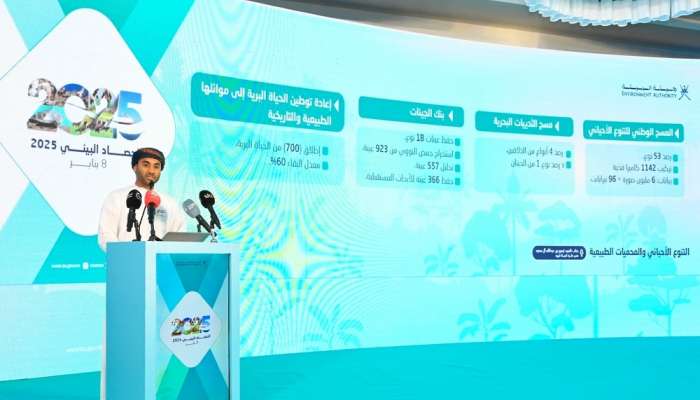
The National Biodiversity Survey, employing 2,400 camera traps, documented 53 terrestrial species, amassing six million images—a colossal 96 terabytes of data. The Marine Mammal Survey, via 54 sea voyages and 1,000 field surveys, identified 56 species, including four dolphin species and one whale species, enriching the repository of precise data on Oman’s marine ecology.
The project for preserving wild animal genetic assets secured 18 species, extracting DNA from 923 samples, analyzing 557, and preserving 366 for future scientific inquiry. Approximately 700 rehabilitated wild animals were reintroduced to their native habitats.
Investment in natural reserves was bolstered by the signing of nine contracts valued at RO 44 million, fortifying the reserves' role in promoting the green economy. Marine environmental quality surveys across 21 coastal sites revealed an exemplary average seawater quality of 96%. Coral reef rehabilitation was elevated through an innovative underwater museum, deploying eight specialized structures to expand and protect coral colonies.
The Red List Index for biodiversity demonstrated marked improvement, rising from 0.89 to 0.98. Conservation triumphs included the release of 290 Arabian Oryx, 390 Reem Gazelles, and 41 Arabian Gazelles. A coastal erosion study targeting the North and South Al Batinah governorates identified critical vulnerable sites, informing strategies to shield coastlines from degradation.
The nationwide Early Warning System for radiation monitoring is fully operational, with all stations transmitting data in real-time, ensuring vigilant oversight. The updated National Plan for Persistent Organic Pollutants engaged over 150 sites, targeting 30 pollutants, with more than 350 samples collected to assess environmental concentrations.
Groundwater and treated wastewater quality monitoring gathered over 220 and 330 samples respectively, achieving an 87% average compliance rate with national standards. Marine pollutant monitoring across 60+ sites collected 130 seawater samples, all conforming to national criteria. Radiation safety cooperation with 230 entities, verified through 220 inspections, confirmed a 95% adherence rate to precautionary measures.
Waste management advancements secured a 39% recycling rate for solid waste, supported by 85 dedicated recycling facilities. A flagship national initiative, the Omani Tree Gardens project, focuses on preserving and reintroducing threatened native flora to secure habitats.
The Sustainable Buildings and Cities Classification Standards, culminating in the "Rowdha Green" certification, have been formalized in two guides featuring 10 determinants for sustainable cities and 7 core axes for sustainable buildings, receiving accreditation from the Gulf Accreditation Centre.
Concluding the conference, the Environment Authority announced the wilayats of Haima, Mahout, Duqm, and Al Jazer in Al Wusta Governorate as victors of the "Green Wilayat" competition, an initiative fostering environmental sustainability and dynamic partnership between government, local communities, and the private sector.