Wednesday 21 / October / 2026
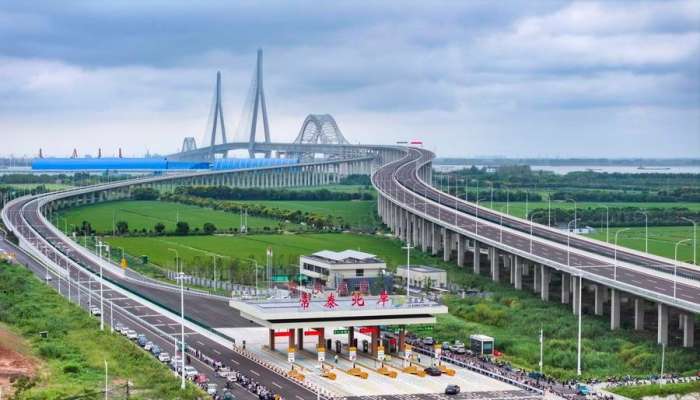
Beijing: China's Yangtze River Economic Belt, a pivotal economic powerhouse, has seen its regional GDP more than double in the course of the past decade, while steering toward a new path that prioritises ecological protection and green growth.
Speaking at a press conference on Monday, Wang Changlin, deputy head of the National Development and Reform Commission, highlighted some telling indicators of this economic belt's high-quality development.
The economic belt currently contributes 47.3 percent of the national economic output, up from 42.2 percent ten years ago, and has significantly boosted the share of sections with good water quality from 67 percent to 96.5 percent. The Yangtze River trunk line has remained the world's busiest inland waterway, as its annual cargo throughput has surged by 71 percent to 4.2 billion tonnes over the past decade.
Stretching more than 6,300 kilometres before emptying into the East China Sea, the Yangtze River is China's longest waterway.
China launched the Yangtze River Economic Belt initiative in early 2016, aiming to transform the region into a golden economic belt featuring more beautiful ecology, smoother transport networks, a more coordinated economy, a better-integrated market and a greater quantity of scientific mechanisms.
Ten years on, the economic belt, comprising 11 provincial-level regions, has emerged stronger with an improved natural environment and new growth impetus from innovation-driven industries.
Jiang Huohua, an official with the Ministry of Ecology and Environment, has hailed the sharp rise in the proportion of good water quality over the past decade as "hard-won," noting that the water quality of the river's main stream has remained at Grade II in the country's five-tier water quality system for six consecutive years.
Efforts have been made in pollution control, ecological restoration, systematic management and risk prevention, Jiang noted. Over 90 percent of black, malodorous water bodies in county-level cities have been cleared, while the total phosphorus level in the Yangtze River Basin has dropped by more than 40 percent from ten years ago.
"Populations of flagship species, such as the finless porpoise, have increased, and the 'mother river' is teeming with new vitality," Jiang told the press.
To restore biodiversity along the river, China implemented a full fishing ban in 332 conservation areas of the Yangtze River basin in January 2020, which was expanded in 2021 to a 10-year fishing moratorium along the river's main streams and major tributaries.
"Sustained conservation and restoration initiatives have led to a steady recovery in aquatic biodiversity," said Jiang Kaiyong, an official with the Ministry of Agriculture and Rural Affairs.
Between 2021 and 2024, a total of 344 indigenous fish species were monitored in the Yangtze River Basin, an increase of 36 species compared to the period before the fishing ban, Jiang revealed.
Strengthened joint enforcement has successfully driven down fishing-related crimes over the past five years, he added, while pledging that the agricultural ministry will work with other authorities to support the high-quality development of the Yangtze River Economic Belt through high-level protection of aquatic biodiversity.
Over the past decade, the Yangtze River Economic Belt has emerged as one of China's most dynamic innovation hubs, as technological advances increasingly translate into both industrial strength and global competitiveness.
It has produced a number of internationally competitive technology companies, including AI startup DeepSeek and stellar robotics maker Unitree Robotics, alongside the rise of world-class industrial clusters in sectors such as automobile manufacturing and electronic information.
Wang Changlin said the government has established three major science and technology innovation centers and eight national laboratories across regions along the Yangtze River, which have supported breakthroughs in core technologies spanning AI, quantum information, integrated circuits and life sciences.
Manufacturing depth has also strengthened. The economic belt has built complete industrial chains in electronic information, automobiles, pharmaceuticals and chemicals. A total of 41 national-level advanced manufacturing clusters and 30 clusters focused on strategic emerging industries have taken shape.
While accounting for roughly one-third of China's total energy consumption and carbon emissions, the economic belt generates nearly half of the country's gross domestic product -- highlighting its leading role in promoting green development.
Looking ahead, policymakers have vowed to accelerate the green transformation of traditional industries along the river, while fostering locally tailored green and low-carbon sectors.
The economic belt will better align economic development with environmental protection, Wang said.