Tuesday 13 / October / 2026
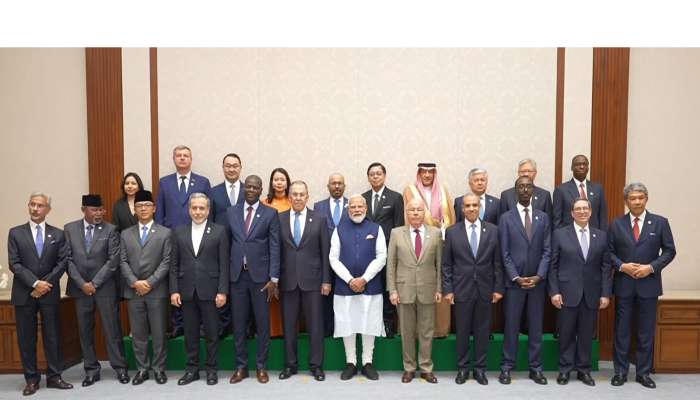
New Delhi: India secured a diplomatic achievement at the 18th BRICS Summit in New Delhi by guiding the expanded grouping towards a joint declaration despite significant differences among members over geopolitical conflicts and the future global order.
Analysts described the outcome as a form of pragmatic consolidation, with India avoiding language that would require members to assign blame over contentious international issues. Instead, the summit focused on areas where cooperation was considered feasible, including trade, technology, agriculture, digital public infrastructure and stronger representation for developing countries.
The 11-member grouping’s joint declaration called for maximum restraint amid tensions in the Middle East, opposed the displacement of Palestinians and warned against the weaponisation of critical minerals and technology. It also criticised protectionist trade measures and rising tariffs without directly naming the United States.
The agreement followed difficulties earlier in the year, when BRICS foreign ministers failed to issue a joint statement in May amid disagreements between new members Iran and the United Arab Emirates over the Middle East conflict. Analysts said India helped bridge those differences by adopting carefully worded language that expressed concern over escalating tensions without assigning responsibility to individual countries.
Manoj Kewalramani, chairman of the Takshashila Institution’s geostrategy programme, said reaching an agreed text required India to balance competing interests while securing broad principles without entering into the politics of assigning blame.
Rityusha Tiwary, an assistant professor of political science at the University of Delhi, characterised India’s chairmanship as pragmatic consolidation rather than a transformation of BRICS. She said New Delhi concentrated on issues directly linked to the development priorities of emerging economies while seeking to strengthen the Global South’s voice without allowing the grouping to become an instrument of Chinese strategic influence.
India also advanced initiatives concerning small businesses, innovation ecosystems, global supply chains, industrial development, agriculture, health, science and technology. However, analysts noted limited progress on the BRICS cross-border payments initiative and the proposed BRICS Grain Exchange.
The summit also highlighted differing approaches between India and China. Chinese President Xi Jinping emphasised reducing Western dominance and expanding BRICS cooperation in artificial intelligence, digital industries, smart manufacturing and talent development. Indian Prime Minister Narendra Modi, by contrast, focused on greater representation for developing nations and a stronger role in global rule-making.
Analysts said these differences illustrate the diverse strategic interests within BRICS. Rather than functioning as a conventional geopolitical alliance, the grouping increasingly operates as a platform for issue-based cooperation among countries that do not share a common strategic outlook.
BRICS now comprises 11 full members and 10 partner countries, while more than 30 other nations have applied or expressed interest in joining. India is preparing to hand the presidency to China, with analysts expecting continuity in areas such as artificial intelligence and climate cooperation.
The future direction of BRICS will therefore depend on how India and China manage their competitive interests while maintaining cooperation within an increasingly diverse grouping.