Wednesday 19 / August / 2026
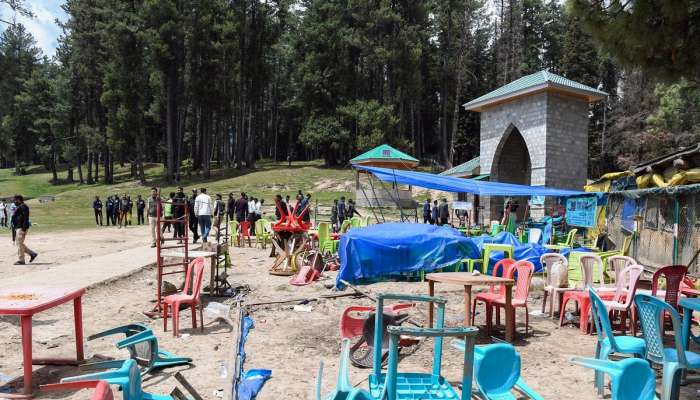
On a spring afternoon in April, when the alpine expanse of Baisaran meadow near Pahalgam would typically echo with the laughter of tourists and the hum of pony rides, terror descended with chilling precision.
The massacre of 26 civilians, including a Nepalese national, on April 22, 2025, was neither spontaneous nor indiscriminate. Survivors and investigative agencies established that the attackers segregated victims based on their religion before executing them in cold blood.
The brutality of the act, carried out in one of Indian administered Jammu and Kashmir's most frequented tourist destinations, sent shockwaves across India and beyond.
As India approaches the first anniversary of the Pahalgam attack, the contours of the incident have become clearer, revealing not only the operational methods of the perpetrators but also the structural ecosystem that enabled it.
The Resistance Front: A rebranded proxy
The group that claimed responsibility, The Resistance Front (TRF), has been widely identified as a proxy outfit linked to Lashkar-e-Taiba.
TRF emerged in recent years as part of a broader strategy to rebrand and obscure the involvement of terror organizations. Its designation as a Foreign Terrorist Organization by the United States reinforced international recognition of its role in orchestrating violence in the region.
Investigations into the Pahalgam massacre underscored that TRF was not an isolated entity but part of a continuum. Its operational patterns, recruitment channels, and ideological messaging closely mirror those of Lashkar-e-Taiba.
Intelligence assessments indicated that TRF functioned as a front designed to lend a veneer of localized resistance while masking cross-border direction and support.
The attack in Baisaran exemplified this hybrid approach. It combined local reconnaissance with external coordination, highlighting a level of planning inconsistent with the narrative of a purely indigenous insurgent group.
Targeting stability and growth
The timing of the attack was not incidental. The Indian administered Jammu and Kashmir had recently witnessed successful electoral processes and a steady uptick in tourism and economic activity.
Official data pointed to record tourist footfall, infrastructure development, and a gradual restoration of normalcy in several districts.
The Pahalgam massacre disrupted this trajectory. By targeting civilians in a high-visibility tourist location, the attackers sought to undermine confidence in the region's stability.
Security agencies noted that such attacks are often calibrated to coincide with moments of perceived progress, amplifying their psychological and economic impact.
The deliberate targeting of tourists—particularly after segregating them on religious lines—also suggested an intent to inflame communal tensions. This tactic, investigators argued, aligned with broader objectives of destabilization rather than any immediate tactical gain.
Evidence and attribution
In the months following the attack, security operations intensified across the Kashmir Valley.
A significant breakthrough came on July 28, 2025, when three terrorists linked to the Pahalgam massacre were neutralised on the outskirts of Srinagar.
The recovery of identification documents provided critical leads.
One of the perpetrators was identified as Habib Tahir, a resident of Koiyan. Another was identified as Bilal Afzal.
Investigators described the evidence as cumulative and consistent. From communication intercepts to logistical trails, the indicators pointed towards a complex network beyond Indian territory.
The presence of individuals from outside among the attackers further complicated claims that such incidents were solely the result of internal dynamics within Jammu and Kashmir.
Evolving architecture of terror funding
Parallel to operational shifts, there has been a marked evolution in the mechanisms of terror financing. Traditional channels—such as hawala networks—have increasingly been supplemented or replaced by encrypted digital transactions.
Security agencies have flagged the growing use of digital wallets and cryptocurrencies to transfer funds, making detection more complex.
These methods offer anonymity and speed, enabling handlers to move resources across borders with reduced risk of interception. Investigations into the Pahalgam attack revealed patterns consistent with this trend, including the use of layered transactions and intermediary accounts.
This financial evolution reflects a broader adaptation by terror networks, allowing them to sustain operations despite heightened scrutiny of conventional funding routes.
Resurgence of organized networks
The Pahalgam attack also coincided with signs of renewed activity among established terror organizations in Pakistan. Reports indicated an expansion in recruitment drives, training modules, and public mobility efforts.
Jaish-e-Mohammad, for instance, has reportedly broadened its outreach, including the formation of a women's wing named “Jamaat-ul-Mominat”.
This development marked a shift in organizational strategy, aiming to diversify its support base and deepen ideological penetration.
Likewise, Lashkar-e-Taiba has expanded its operational capabilities.
Intelligence inputs suggested the establishment of specialized training units, including a “Water Wing” designed to impart maritime tactical skills. Such initiatives point to a long-term investment in capacity building, rather than a contraction under international pressure.
Public rallies, training camps, and speeches with anti-India rhetoric have continued to surface, indicating that these organisations remain active within Pakistan’s landscape.
A pattern of denial and continuity
This pattern has been observed in previous incidents as well, where attribution has been contested even in the face of documented links.
The persistence of such responses has drawn scrutiny from international observers. Analysts have noted that the use of proxy groups allows for plausible deniability, complicating diplomatic and legal accountability.
However, the cumulative record—from the identification of perpetrators to the tracing of logistical networks—has continued to challenge these denials.
The Pahalgam attack, in particular, added to a series of incidents that have been cited as evidence of sustained support for non-state actors targeting India.
Remembering Pahalgam
As April 22 approaches, the anniversary of the Pahalgam massacre serves as a moment of reflection. The images from Baisaran meadow—of a tranquil landscape turned into a site of violence—remain etched in public memory.
The attack was not only a human tragedy but also a demonstration of the enduring complexities surrounding security in the region. It highlighted the intersection of local vulnerabilities and cross-border influences, as well as the evolving tactics of groups operating under shifting identities.
One year on, the facts surrounding the incident have coalesced into a clearer narrative.
The role of The Resistance Front as a proxy, and the broader ecosystem of support have all been documented through investigations and security operations.
The unresolved shadow
The Pahalgam attack did not occur in isolation. It formed part of a broader pattern in which non-state actors continue to operate with varying degrees of sophistication and support.
The evolution of funding mechanisms, the resurgence of established groups, and the strategic use of rebranded entities all point to an adaptive threat landscape.
As India commemorates the first anniversary of the massacre, the focus remains on the facts that emerged from the investigation. These facts underscore a continuity that extends beyond a single incident, reflecting deeper structural dynamics.
The meadow at Baisaran has returned to its natural rhythm, with tourists once again traversing its slopes. Yet the events of that April afternoon linger as a reminder of how quickly normalcy can be disrupted—and how the forces behind such disruptions continue to evolve.